With the rise of artificial intelligence and all sorts of new cutting-edge manufacturing technologies, we are witnessing the emergence of a new Industrial Revolution. This is already reshaping the luxury industry across multiple layers, from AI-generated adverts to AI-assisted design.
Results have been mixed. Yet long before AI, the unceasing integration of technology into our lives has led to a resurgence of craft as an aspiration for creatives and consumers alike. The widespread anxiety around soulless consumption and a desire for something touched with human hands, rather than workshopped by market research and generated by machines, has powered the status of craft to new heights.
This has been particularly pronounced in the world of luxury. The craft renaissance is everywhere. Take Jonathan Anderson, recently elevated to Creative Director of Dior. His promotion follows years of putting craft at the heart of his work at Loewe and his own brand, JW Anderson. More tellingly, Anderson's recently-opened British craft-led store in the heart of British craft territory on London's Pimlico Road is a power statement that British craft is back and bigger than ever.
However, through my work with Nation of Artisans, I've been exploring Britain through the lens of the strange alchemy of heritage craft, industrial power, and cutting-edge innovation. While I personally welcome the return of the hunger for craft, I fear that something deeper is being lost in the discourse. Many of the greatest innovations (in luxury and beyond) have come from creative industrialists who have done the tricky work of merging the best of craft wisdom with the power of technology.
Indeed, many of Britain's most iconic businesses are a result of this marriage of craft and technology. Master potter Josiah Wedgwood sought to industrialise the craft of ceramics, streamlining the pottery process through slip casting while elevating the craft of surface art to new heights. Meanwhile, Sir Henry Royce and Charles Stewart Rolls built motorcars where engineering precision and handcraft were inseparable, with every component being assembled and finished by craftsmen with meticulous attention.
This battle between craft and technology is etymologically nonsensical. The word technology comes from the Greek techne, meaning art, craft, or skill. This word traces back to the Proto-Indo-European root tetḱ: to create, produce, or build. The concepts are inseparable.
Today, when people talk of craft as a form of resistance to technology, I suspect what they truly mean is the loss of the humans in the loop. Yet the notion that craft and technology should be locked in conflict with one another is both ahistorical and unproductive.
The British historian Alexander Langlands prefers to use the term “cræft” which is derived from the 9th century works of King Alfred the Great. This defines craft as the virtuous application of power and skill in harmony between hand, eye, mind, body, tools, and materials to create excellence.
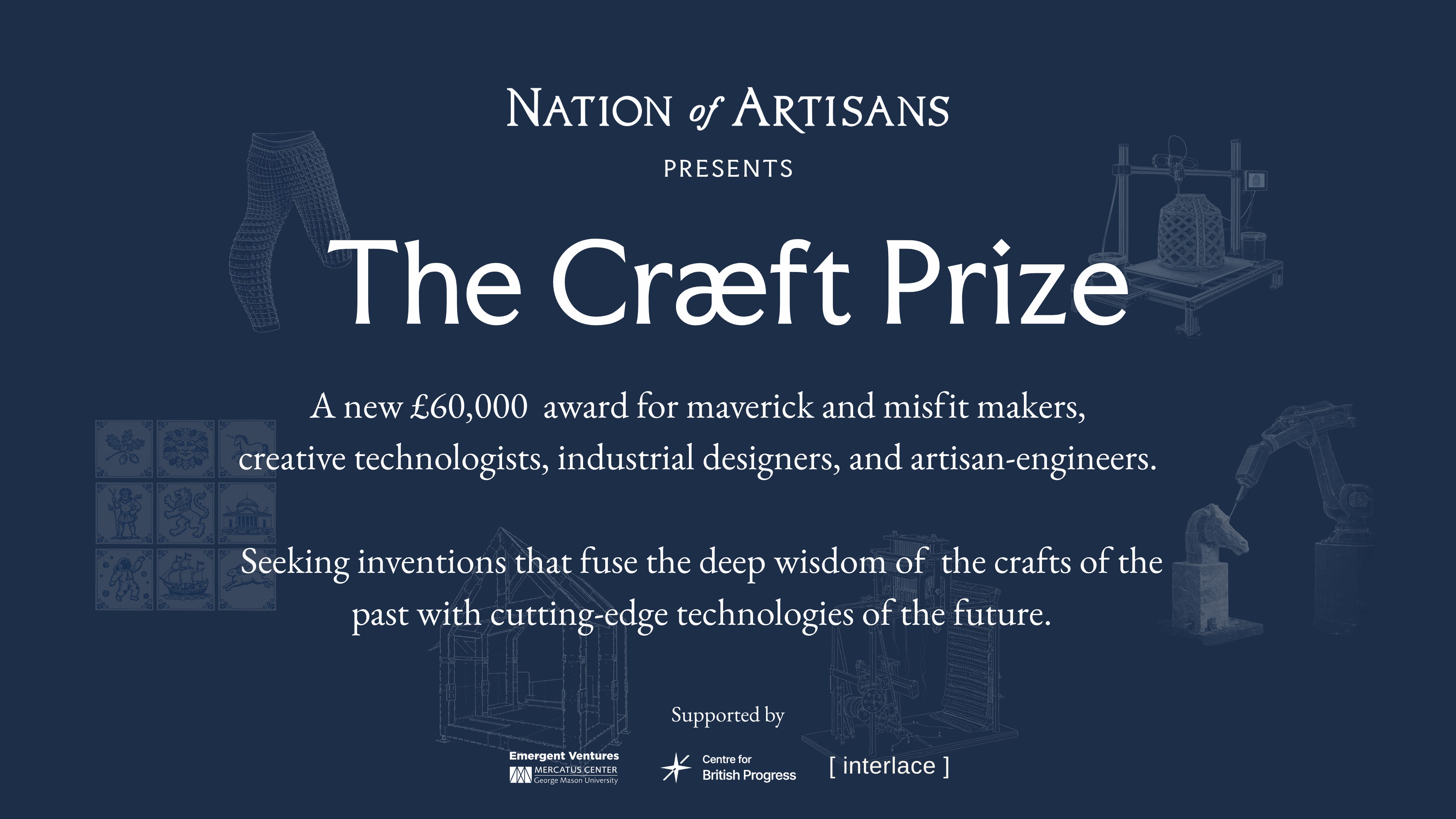
So fascinated by this tension, and Langlands' deeper definition, I have launched the The Cræft Prize, which searches for the next generation of pioneers who combine the deep wisdom of craftsmanship with the cutting-edge technologies of the future to create magical new products and processes.
Following William Morris, the prize rejects technology that produces ugly, soulless, and inhumane things, seeking instead the union of beauty and utility embodied in the Kelmscott Press. In the spirit of Josiah Wedgwood, I see technology not as the enemy of craft but as a means of extending it: using invention and manufacturing to create elegance and usefulness at scale.
Indeed, I was inspired by some members of the Walpole family following in Morris and Wedgwood's footsteps, including Brands of Tomorrow graduate Petit Pli, who combine advanced aerospace materials with the craft of pleating and origami to make clothes that grow. Elsewhere, I was fascinated to discover that British stonemasonry companies are turning to CNC mills to support masons by doing the rough cuts.
Fascinated by these examples, The Cræft Prize asks: how else can cutting-edge technology and the wisdom of craftsmanship be reintegrated to create wonderful new things?
The application window for the prize closes on 31st August 2026, and I invite Walpole members working on projects big or small that combine craft and technology to submit what they are working on to the prize.
Six nominees will be selected, each receiving £5,000 to scale up their work into an exhibit which will be featured at an exhibition in 2027 where a winner will be selected who will receive another prize of £30,000.
I am also delighted to share that Helen Brocklebank, CEO of Walpole, will be a judge of the prize.
Find more information about the The Craeft Prize, its submission requirements and brief via the Nation of Artisans website, Instagram and Substack.
If you have any questions about the The Craeft Prize, please email [email protected]