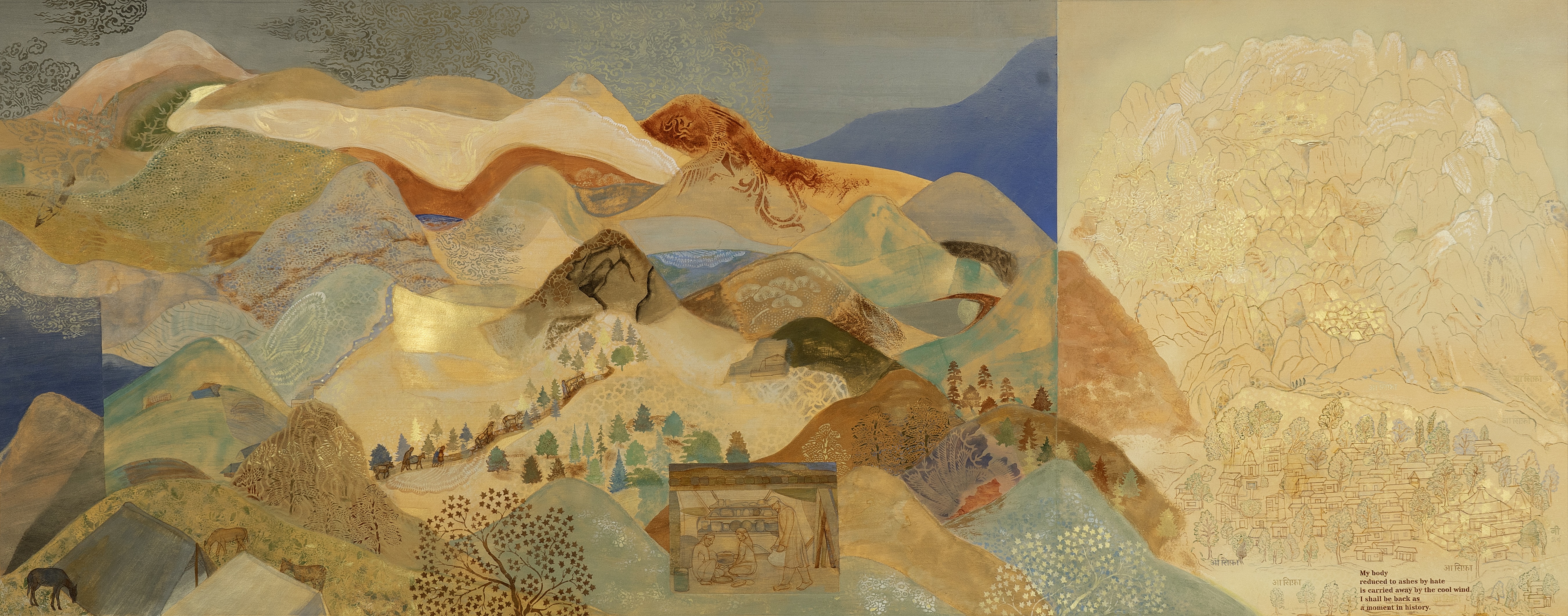
Three horses – two brown, one black – are drawn in long pencil strokes. They bow their heads to the ground, but what they graze is not quite grass. Instead, it’s a delicate study of leaves: some spindly, others stout. These horses roam a hill that rolls across the bottom left-hand corner of Nilima Sheikh’s Home, Land 2. Much of its width is dedicated to depicting the Kashmiri mountains in washes of blue, gold, and orange, with each peak draped in a different design. One resembles the tessellation on a giraffe’s hide, another a Japanese-style dragon, and another Moorish geometric tiling. A third of the piece is different to the rest. There’s a sketch outlined, but it’s uncoloured and unadorned, as if unfinished.
Home, Land 2 hangs in the final gallery of A Story of South Asian Art: Mrinalini Mukherjee and Her Circle – the latest exhibition to open at The Royal Academy of Art. The show, open until Tuesday 24th February 2026, focuses on the artistic principles that emerged from Visva-Bharati University in Santiniketan, India. Unlike other schools, this rural Bengali institution was defined not by a particular aesthetic or practice, but by a belief in art as expansive and unbounded, departing from Western hierarchies of artistic expression to equally value diverse traditions.
Sheikh, along title artist Mrinalini Mukherjee and others, embraces the attitudes of Visiva-Bharat alum and teacher, K.G. Subramayan, who collapsed hierarchies between fine art and craft, and looked to pluralisms within Indian cultural histories. ‘Our art tradition has few parallels in the world for its depth, breadth, antiquity and diversity,’ he wrote in 1971.
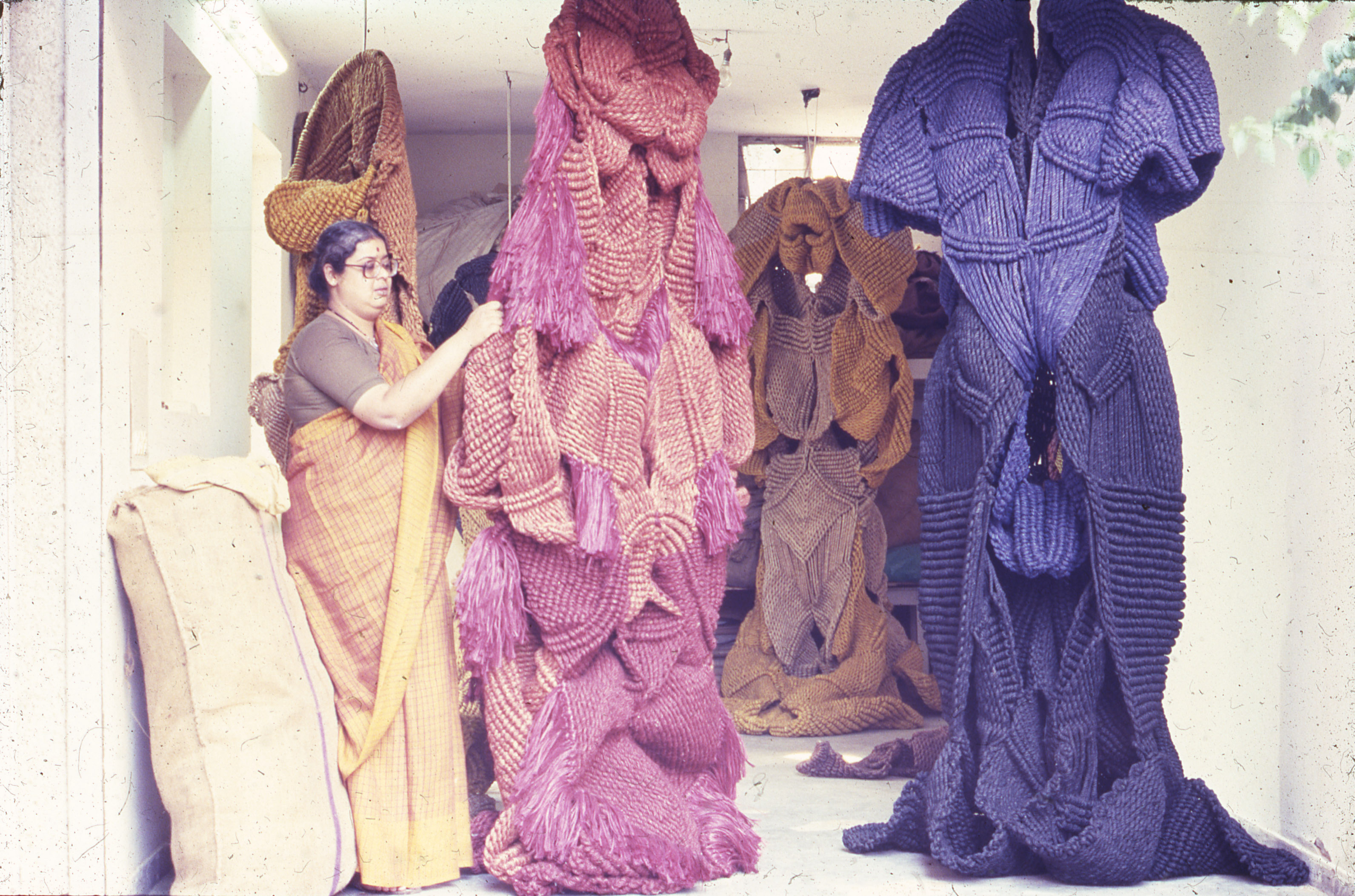
In Sheikh’s Home, Land 2, this plurality manifests through the layering of patterns gathered from across worldwide visual lineages. Mukherjee’s early career sculptures, however, channelled this plurality through the use of local, traditionally ‘poor’ materials such as hemp and jute in an adaptation of the ancient Arabic knotting technique of macramé.
“What happens when you centre South Asian art in world culture?" is the question that curator Tarini Malik hopes to pose through A Story of South Asian Art. The show brings to London many pieces that have never exhibited outside of India before, a selection of which shall form The Hepworth Wakefield’s major retrospective of Mukherjee, opening in mid-2026. Together, the works both challenge conventional European Modernism, and advocate for an understanding of Modernism as a dialogue between multiple traditions. “It is the space for discussion that this exhibition seeks to honour,” Malik says.
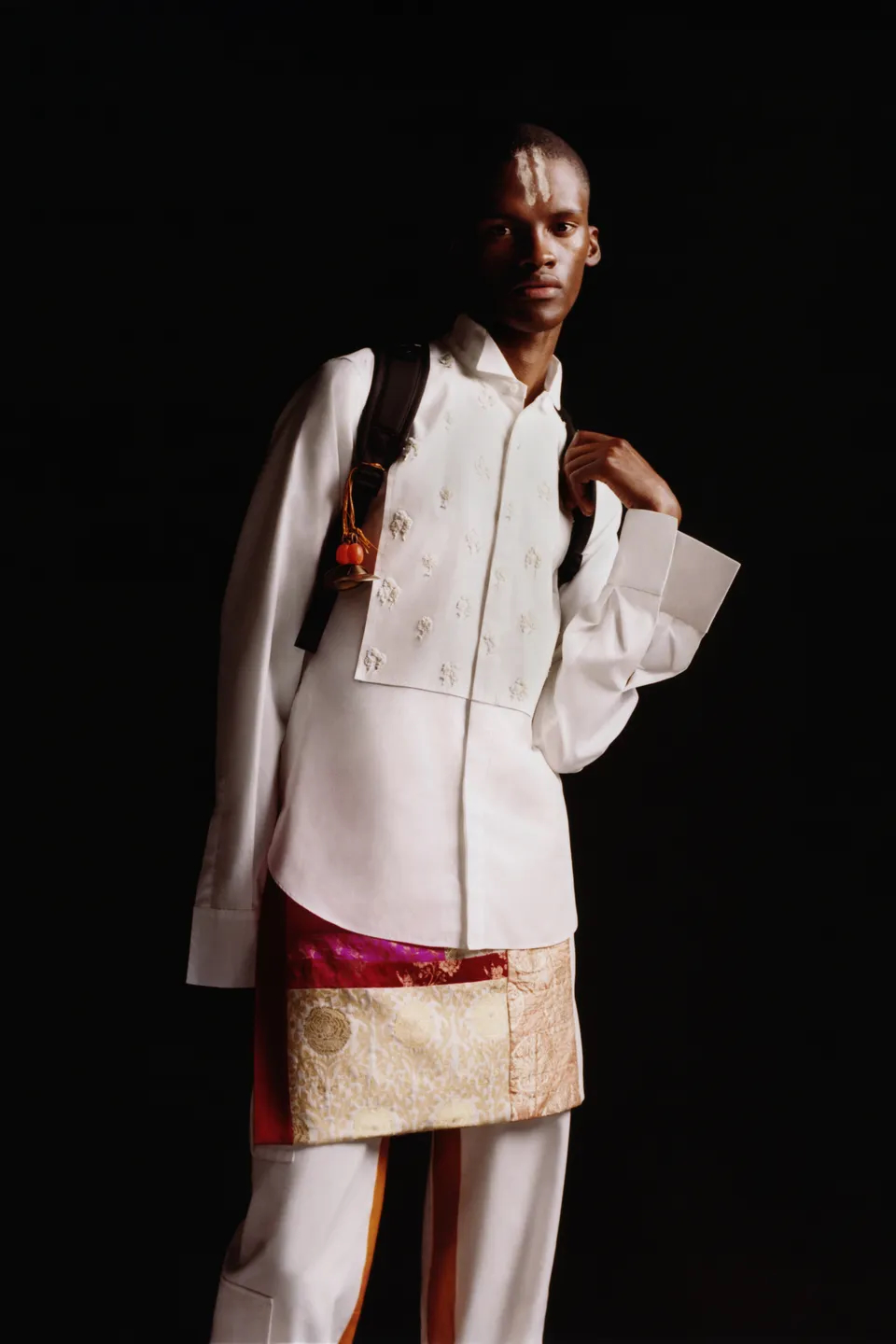
Much like Sheikh’s ‘unfinished’ Home, Land 2, this conversation is incomplete, ongoing. For Shah Rukh Khan’s 2025 Met Gala look, Indian couturier and Walpole British Luxury Summit 2025 speaker, Sabyasachi Mukherjee reworked British colonial-era and indigenous Hindustani style in local Indian materials with Japanese, French and Tasmanian fabrics. His response not only resonated with the defiant nature of the Superfine: Tailoring Black Style theme, but honoured the principles of Indian Modernism, too. Channelling Visva-Bharat’s ethos, in 1965 Subramayan wrote that artists would be ‘richer… if [they] work in various dimensions’. This belief is echoed in Sabyasachi’s reflections on his multi-layered design, commenting that the look “brought our own version of Black dandyism with a uniquely Indian exuberance. Formal for sure and richer indeed.”
Such plural design is not restricted to the bounds of India: on London’s Savile Row, clothsurgeon’s Rav Matharu is collapsing hierarchies between English sartorial traditions and relaxed street style, re-constructing sportswear fabrics into bespoke suits. And Grace Wales Bonner, recently announced as Creative Director of Hermès men’s wear, embraced the principles of Indian modernity when she collaborated with Raw Mango for her SS19 collection, blending brocades traditionally used in Indian formalwear with functional clothing to create looks in her own distinctive visual language.
When he founded Visva-Bharati, Nobel laureate Rabindranath Tagore hoped to create a place “where the mind could have its fearless freedom to create its own dreams.” What feeling would come of knowing that these minds now grow in places like London, Paris and New York, redefining fashion codes and leading foremost international houses?
A Story of South Asian Art: Mrinalini Mukherjee and Her Circle runs until 24th February 2026 at the Royal Academy of Arts, Burlington House, Piccadilly, London W1J 0BD. royalacademy.co.uk
Gallery view of ‘A Story of ‘A Story of South Asian Art: Mrinalini Mukherjee and Her Circle’, 31 October 2025 - 24 February 2026, at the Royal Academy of Arts, London. Photo: © Royal Academy of Arts, London / David Parry
Daily Luxury Digest
Sent every working day, the Daily Luxury Digest is your essential news source for the latest developments in the luxury sector both in the UK and around the world.