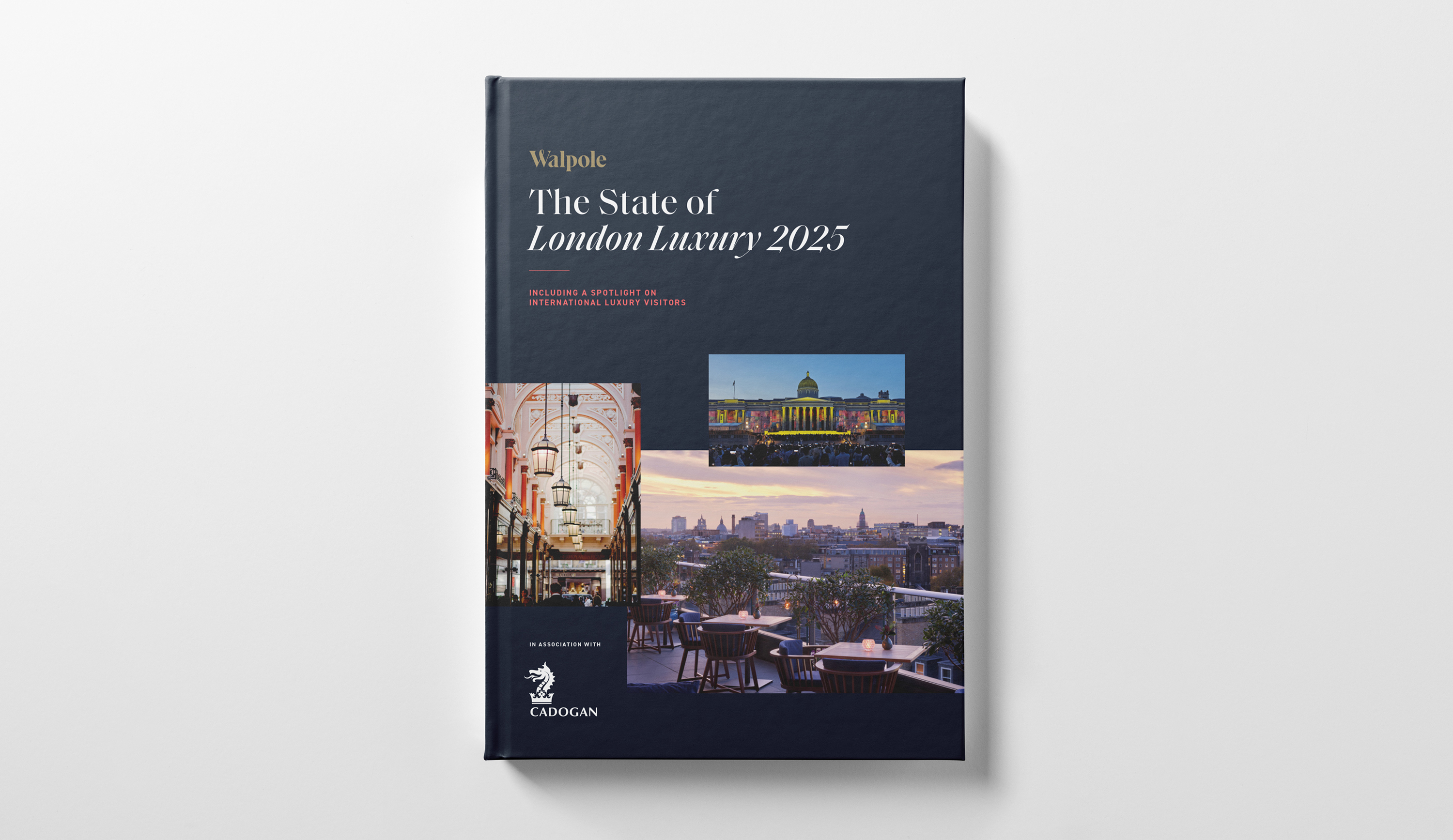
Read The State of London Luxury 2025

Walpole News
1st October 2025

London has been reaffirmed as Europe’s leading hub for luxury and wealth creation, according to the third edition of our The State of London Luxury report, created in partnership with Cadogan. The report, comprising interviews and a comprehensive survey of industry leaders, underscores London’s continued global influence, highlighting the city’s appeal to high-spending international visitors, investors, and residents.

However, the study warns that increased global competition threatens London's luxury market leadership despite the sector's £81bn contribution to the UK economy.

This third edition of the report reveals that wealth creation in the UK will accelerate faster than any other European market, with forecasts showing a $2.4tn increase between 2024 and 2029 – nearly double other European markets. At the very top end, London maintains its lead with 352 centi-millionaires (individuals worth over $100mn), significantly ahead of Paris, Milan and Frankfurt.

London remains Europe’s most powerful luxury hub, a city that attracts wealth, investment and the world’s highest-spending visitors. Their contribution is significant not just to the capital but to the entire UK luxury sector, which generates £81bn in value and supports 450,000 jobs. Yet, as our research shows, competition for international tourists and capital is fiercer than ever. London must act decisively to protect its leadership and keep this international spending in the UK by supporting policies that enhance competitiveness, particularly in tourism promotion, investment incentives and talent access.

Below, read a more detailed overview of the content of The State of London Luxury 2025 report, as well as key facts and figures.

Walpole would like to thank all of the members and contributors who have supported the report including Agility Strategy & Research, CBRE, Global Blue, Harrods, Henley & Partners, Knight Frank, Oxford Economics, Tong Global, UBS Global Wealth and VisitBritain – the study would simply not be possible without their input, insights and data.

London remains Europe’s most powerful luxury hub, a city that attracts wealth, investment and the world’s highest-spending visitors. Their contribution is significant not just to the capital but to the entire UK luxury sector, which generates £81bn in value and supports 450,000 jobs. Yet, as our research shows, competition for international tourists and capital is fiercer than ever. London must act decisively to protect its leadership and keep this international spending in the UK by supporting policies that enhance competitiveness, particularly in tourism promotion, investment incentives and talent access.

Helen Brocklebank
CEO, Walpole

Key takeaways

  • London is the most visited destination in the world, with 17mn overnight visitors recorded in 2024, four million more than Paris.

  • High-spending tourists, who stay in five-star hotels, spend 14 times more than average visitors and contribute £30bn to the UK economy.

  • London leads Europe with 352 centi-millionaires, well ahead of Paris (227) and Milan (182).

  • Luxury hotel occupancy has returned to pre-pandemic levels (82%) with investment doubling in 2024 and £4.5bn forecast for 2025, driving the largest wave of openings since 2014.

  • Luxury contributes £81bn to the UK economy, supporting 450,000 jobs.

Tourism is an increasingly important growth driver

International visitors continue to power London's luxury economy, with the capital recording 17 million overnight visitors in 2024 – four million more than Paris. High-spending tourists (defined as those who stay in five-star accommodation), who spend 14 times more than average visitors, contribute £30 billion of the UK's £85bn tourism economy, demonstrating luxury travel's critical role as a lever for national growth. This spend flows throughout the wider UK economy, supporting regional growth and supply chains far beyond the capital.

Heathrow's position as the world's most connected hub was reinforced with 84.2 million passengers in 2025, with high-spending visitors from the US, China and GCC representing the greatest opportunity for British luxury businesses. US visitors spent a record £7.3bn in the UK in 2024, while Chinese visitors, following a slow post-pandemic recovery, are forecast to surge 46% in 2025 with spending projected to reach £1.6bn, up 77% year-on-year. GCC visitors, though smaller in number, sustain high spending throughout the year (except during Ramadan) and spread their purchases widely across categories unlike Chinese visitors who focus on select super brands.

London’s cultural offer is the city’s strongest draw, with 17 of the UK’s top attractions located in the capital. Visitor spending also underpins the UK’s museums, galleries and heritage institutions, helping sustain the cultural assets that make London and the wider UK globally distinctive. This cultural magnetism, combined with a diverse luxury retail landscape, makes London a leading destination for global HNWIs. Its dining scene also plays a critical role: 85 Michelin-starred restaurants place London among the world’s top five culinary destinations, with fine dining ranked the number one VIP experience for Chinese visitors specifically.

Hotel investment accelerates

London is undergoing its largest wave of luxury hotel openings since 2014, with 757 new rooms due in 2025. Many groups are also refurbishing existing properties, and occupancy has returned to pre-pandemic highs at 82%.

The city’s stock of high-end hotel rooms is set to reach 21,000, with investment transactions doubling in 2024 compared to 2023. CBRE forecasts £4.5bn in hotel investment for 2025.

London luxury retail resilience

London continues to lead global luxury retail, blending iconic international houses with emerging British talent across department stores, luxury districts and affluent villages. Luxury retail vacancy rates remain below 5%, signalling strong resilience and long-term appeal.

Bond Street rents have risen more than 90% since 2015 demonstrating sustained demand while brands including Rolex, Moncler, Temperley London, L’Objet and Van Cleef & Arpels opened new flagships across Bond Street and Sloane Street in 2024. Prada’s £250mn freehold purchase of Miu Miu’s Bond Street site underscores long-term confidence in London’s prime retail, while the £50mn transformation of Sloane Street into an elegant green boulevard completed earlier this year and strengthens London’s position as a luxury retail destination.

Experiential retail is also on the rise, with activations such as Louis Vuitton x Murakami in Soho and Chanel’s Rouge Coco Playground in Covent Garden designed to create high-impact social media moments as well as sales.

“Luxury faces challenges globally and to ensure that London continues to thrive, we must invest even more into its vibrant ‘ecosystem’ - the right balance of characterful flagship and independent retail, incredible cultural spaces, enticing restaurants and hotels - to create a joyful experience that enchants locals and visitors alike.”

Hugh Seaborn
CEO, Cadogan

Wellness and residential property drive London’s next wave of luxury growth

London is emerging as the global capital for luxury living, with wellness-focused residential property leading growth. The UK is now the world’s third-largest wellness real estate market, valued at $38.5bn and up 35% year-on-year. Homes with integrated wellness facilities command premiums of 10–25%, as UHNWIs increasingly see wellness as both a lifestyle priority and a value driver.

London also remains Europe’s largest and most mature market for $10mn+ properties, attracting international buyers who view the city as a safe and desirable long-term investment.

A city under pressure

Despite these strengths, concerns remain over London’s competitive position. Nine in ten respondents to the London Luxury Survey said the city now faces tougher global competition and believe it must sharpen its competitive edge to maintain leadership.

The report identifies several challenges undermining London's appeal, particularly the loss of incentives for international visitors, which has damaged high-end visitor spending recovery. Recent policy changes, including Employer National Insurance increases and proposed business rates reforms, risk further undermining competitiveness. Targeted investment in tourism promotion and improved access to European talent through extended Youth Mobility Schemes would help to bolster London's competitiveness.

Read The State of London Luxury 2025


DOWNLOAD

Enquire about Joining

Forename*
Surname
job title
email*
Brand*
TURNOVER
message*
Thank you. This form has been submitted

Membership Fees

Membership Tier
01
02
03
04
05
Brand Turnover
£5-10m
£10-20m
£20-40m
£40-100m
£100m+
Membership Fee
£7,000
£10,000
£15,000
£22,500
£36,000

Membership Guide

Please provide your details to download this document

Forename*
Surname
email*
SUBMIT
Thank you. This form has been submitted
Oops! Something went wrong while submitting the form.
Get the latest luxury talking points, sector news and industry insights in your inbox each day by signing up to our newsletter, the Daily Luxury Digest.

Daily Luxury Digest

Sent every working day, the Daily Luxury Digest is your essential news source for the latest developments in the luxury sector both in the UK and around the world.

Thank you! You have been subscribed to the Daily Digest